
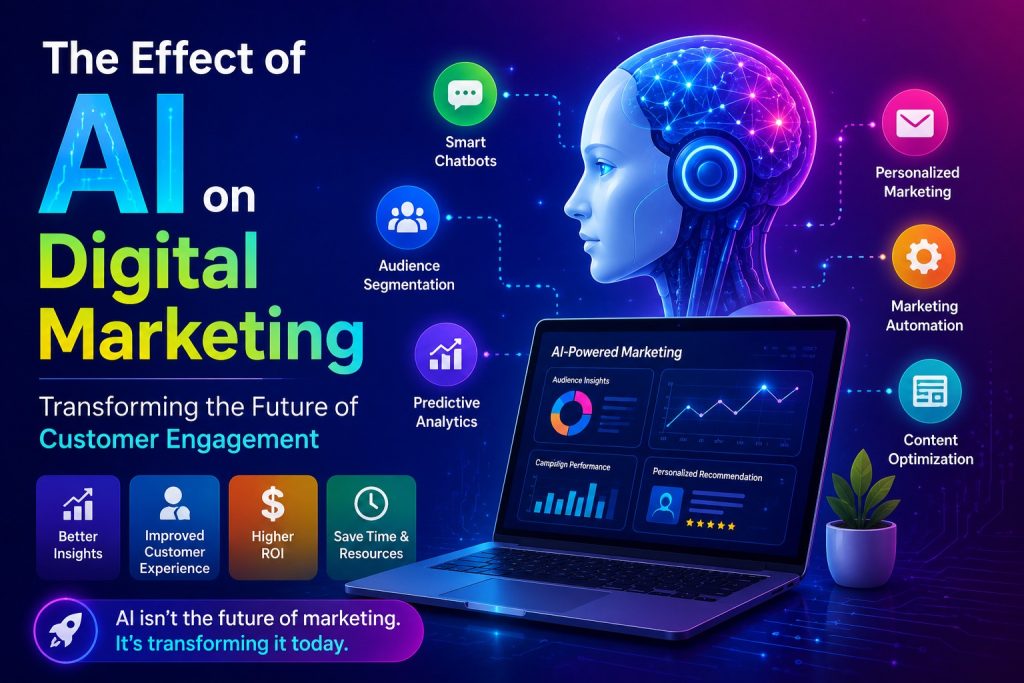
Artificial Intelligence (AI) has rapidly evolved from a futuristic concept into an essential part of modern business. Among the industries experiencing the greatest transformation is digital marketing. AI is changing how businesses understand customers, create content, personalize experiences, and optimize marketing campaigns. By combining data analysis, automation, and machine learning, AI enables marketers to make smarter decisions and deliver more relevant experiences to consumers.
As customer expectations continue to rise, companies that embrace AI gain a competitive advantage by improving efficiency, reducing costs, and increasing return on investment (ROI). However, while AI offers tremendous opportunities, it also presents challenges related to privacy, ethics, and maintaining the human touch in marketing.
AI-Powered Customer Insights
One of AI’s greatest strengths is its ability to analyze massive amounts of data in real time. Every interaction customers have with a website, mobile app, email, or social media platform generates valuable information. AI processes this data far more efficiently than traditional analytical methods.
Marketers can identify purchasing behaviors, customer preferences, browsing patterns, and demographic trends. These insights help businesses understand what customers want, when they want it, and how they are likely to respond to marketing campaigns.
Predictive analytics, powered by AI, allows businesses to forecast future customer behavior. Companies can predict which customers are likely to make purchases, unsubscribe from services, or become loyal brand advocates. This enables marketers to target the right audience with highly relevant campaigns.
Personalized Customer Experiences
Personalization has become one of the most important factors in successful digital marketing. AI enables businesses to deliver personalized experiences on a scale that would be impossible manually.
Streaming platforms recommend movies based on viewing history, e-commerce websites suggest products according to previous purchases, and email campaigns send customized offers based on customer interests. These personalized interactions improve customer satisfaction and significantly increase conversion rates.
AI can also personalize website content in real time by displaying different products, banners, or promotions depending on the visitor’s behavior, location, or preferences. This creates a more engaging user experience that encourages longer visits and higher sales.
AI in Content Creation
Creating high-quality content consistently is a major challenge for marketers. AI-powered writing tools help generate blog posts, social media captions, product descriptions, email newsletters, and advertising copy more quickly than ever before.
While AI cannot fully replace human creativity, it can assist with brainstorming ideas, improving grammar, optimizing headlines, and generating first drafts. This allows content creators to focus on strategy, storytelling, and brand voice rather than repetitive writing tasks.
AI also helps marketers optimize content for search engines by identifying relevant keywords, analyzing competitors, and suggesting improvements that enhance visibility in search results.
Smarter Search Engine Optimization (SEO)
Search engine optimization has become increasingly data-driven, and AI plays a significant role in improving SEO strategies.
AI tools analyze keyword trends, user search intent, website performance, and competitor content to identify opportunities for higher rankings. They also help optimize page structure, internal linking, readability, and metadata.
Modern search engines themselves use AI to understand user intent rather than simply matching keywords. This means businesses must create valuable, informative, and user-focused content rather than relying solely on keyword density.
Voice search, powered by AI assistants, has also changed SEO practices. Marketers now optimize content for conversational queries and natural language searches to improve visibility.
AI-Driven Advertising
Digital advertising has become far more efficient with AI. Advertising platforms use machine learning algorithms to optimize bidding strategies, identify high-performing audiences, and automatically allocate budgets to maximize campaign performance.
AI continuously monitors campaign metrics such as click-through rates, conversions, and customer engagement. Based on this data, it adjusts targeting, bidding, and ad placements in real time.
Programmatic advertising, powered by AI, automates the buying and selling of digital ad space. Instead of manually negotiating placements, AI selects the most effective advertisements for the right audience at the right time.
This improves advertising efficiency while reducing wasted marketing expenditure.
Chatbots and Customer Support
AI-powered chatbots have transformed customer service by providing instant assistance around the clock. Modern chatbots answer frequently asked questions, recommend products, assist with purchases, and resolve common customer issues without human intervention.
These virtual assistants improve customer satisfaction by reducing response times and offering immediate support.
Advanced AI chatbots use natural language processing (NLP) to understand customer questions and respond in a conversational manner. When necessary, they can seamlessly transfer complex inquiries to human representatives.
As AI technology continues to improve, chatbots are becoming more intelligent and capable of handling increasingly sophisticated interactions.
Social Media Marketing
AI has become an essential tool for managing social media campaigns. It analyzes engagement metrics, identifies trending topics, and recommends the best times to publish content.
Social listening tools powered by AI monitor online conversations about brands, products, and competitors. Businesses can quickly identify customer sentiment, emerging trends, and potential public relations issues.
AI also assists in generating creative content ideas, analyzing campaign performance, and identifying influencers whose audiences align with a company’s target market.
This enables marketers to make data-driven decisions rather than relying solely on intuition.
Marketing Automation
Automation is one of AI’s most valuable contributions to digital marketing. Routine tasks such as email scheduling, lead nurturing, audience segmentation, customer follow-ups, and campaign reporting can now be handled automatically.
Marketing automation platforms use AI to determine the best time to send emails, personalize messaging, and trigger actions based on customer behavior.
This allows marketing teams to focus on strategic planning, creative development, and relationship building while AI handles repetitive operational tasks.
Challenges of AI in Digital Marketing
Despite its many advantages, AI also presents several challenges. Privacy concerns have become increasingly important as AI relies heavily on collecting and analyzing customer data. Businesses must comply with data protection regulations and maintain transparency regarding how customer information is used.
Another challenge is maintaining authenticity. While AI can generate content quickly, excessive automation may produce generic messaging that lacks emotional connection. Human creativity remains essential for storytelling, brand identity, and building trust.
There is also the risk of algorithmic bias. AI systems learn from historical data, which may contain biases that affect marketing decisions. Organizations must regularly monitor AI systems to ensure fairness and accuracy.
The Future of AI in Digital Marketing
The influence of AI on digital marketing will continue to grow as technology advances. Future developments may include hyper-personalized customer experiences, predictive customer journeys, advanced voice and visual search capabilities, and even more sophisticated content generation.
Businesses that combine AI with human creativity will be best positioned for long-term success. Rather than replacing marketers, AI will serve as a powerful assistant that enhances productivity, improves decision-making, and enables more meaningful customer interactions.
Conclusion
Artificial Intelligence has fundamentally transformed digital marketing by improving customer insights, personalization, content creation, advertising, automation, and customer service. Organizations that effectively integrate AI into their marketing strategies can improve efficiency, increase customer satisfaction, and achieve stronger business results.
However, successful AI adoption requires balancing automation with human creativity, ethical data practices, and authentic customer engagement. As technology continues to evolve, AI will not replace marketers—it will empower them to create smarter, more personalized, and more impactful marketing experiences.
The future of digital marketing lies in the collaboration between intelligent machines and creative professionals. Businesses that embrace this partnership today will be better equipped to meet the evolving expectations of tomorrow’s customers.